
The 7 Behaviors Your Child Uses To Ask For YOU — And The 10-Minute Science-Backed System That Finally Lets You Answer
Without guessing what your child needs, without expensive therapy, and even if you've been misreading those signals for years
If you recognized even one of those 7 signals in your child — the meltdowns, the "I hate you's," the shutting down — you're not dealing with a behavior problem.
Child neuroscience now confirms these are distress signals.
And there is a specific, repeatable way to respond to each one.
That's exactly what this system teaches.
If You're Like Most Busy Parents...
Stop me when this sounds familiar...
It's 7:43am. You're already running late. Your kid won't put their shoes on.
You've asked four times. You hear yourself getting louder and you know — you can feel it in your chest — that you're about to lose it. And then you do.
By 8:15 you're in the car, your child is quiet in the back seat, and the guilt has already settled in like a stone. You promise yourself this is the last time.
It's not the last time.
By dinner, you're walking on eggshells. By bedtime, there's a wall between you that you can't quite name. You kiss them goodnight and they don't reach back the way they used to.
You tell yourself it's a phase.
What I wish someone had told me was — it's not a phase. It's a pattern. And patterns don't break on their own just because you want them to badly enough.
You've already tried:
Counting to ten — it works until it doesn't, which is exactly when you need it most.
The "gentle parenting" scripts — they sound great on Instagram and fall apart on a Tuesday morning over a spilled bowl of cereal.
The books — you've highlighted them, sticky-noted them, and still screamed on day three.
The apologies — you've said sorry so many times that even you don't fully believe yourself anymore.
After three years of trying everything that didn't work, I learned something that none of those books, courses, or Instagram accounts ever told me:
you were never failing at patience. You were missing a mechanism.
Not a mindset. Not a morning routine. A mechanism.
And the second I found it, everything changed.
"I read this after screaming at my son over homework. I sat in my car for 10 minutes before going back inside. I did the repair. He hugged me first. I've been waiting 2 years for him to hug me first."
— Danielle M., mom of 1 boy, age 9 | Dallas, TX

✅30-Day "Calmer Home" Guarantee — Keep everything even
if you refund Instant access. Start tonight.
Here's The Truth No One Wants To Say Out Loud...
Right now, there are two kinds of parents.
The first kind ends every night replaying the same moment on loop. The raised voice. The look on their child's face.
The door that closed a little too hard. They lie awake telling themselves "tomorrow will be different" — and they've been saying that for months.
The second kind?
They mess up too. They yell sometimes. They're not calm 24/7. But they know one thing the first kind doesn't:
How to repair in under 60 seconds.
And because of that one skill, their child's trust grows stronger every single week — not despite the hard moments, but because of what happens right after them.
I was the first kind for years.
What I'm about to share turned me into the second.
And it has nothing to do with staying calm, counting to ten, or being a better version of yourself. It has everything to do with what you do in the minute after you weren't.
The Moment Everything Changed
When my daughter was 6 years old, I was the parent who had it all figured out — at least on the outside.
I read the books. I followed the experts. I knew all the "right" things to say. But behind closed doors, something was breaking.
The mornings started with rushing. The afternoons ended with nagging. And by bedtime, I was running on empty — short-tempered, overwhelmed, and barely holding it together.
I told myself it was normal. "All parents yell sometimes." "She'll forget about it." "Tomorrow I'll do better."
But tomorrow never came.
One evening, after a particularly bad day, I lost it. Over something small — a spilled cup of juice. I yelled. Not just raised my voice. I yelled.
The kind of yell that echoes through the house and leaves silence behind it.
My daughter looked at me. Not with anger. Not with defiance. With something far worse.
Fear.
And then, through tears, she whispered five words that shattered my entire world:
"I don't want you as my mom. I want a different mom."
I stood there frozen. My hands were shaking. My chest felt like it was caving in.
I walked to the bathroom, closed the door, and cried. Not because I was angry at her.
Because I knew she was right to feel that way.
I was the monster. I was the one she was afraid of. The person who was supposed to make her feel safe — was the one making her feel scared.
That night, I sat on the edge of my bed and made a decision. Not a "I'll try harder tomorrow" decision. A real one.
Not to do better. To understand why.
Why did I keep snapping — even when I loved her more than anything? Why did every parenting technique I tried seem to work for other moms but not for me?
Why was knowing the right thing to do never enough to actually do it?
I didn't have the answers yet. But that night, I committed to finding them — no matter how long it took.
So I started where every desperate parent starts. I bought more books.
How to Talk So Kids Will Listen. Peaceful Parent, Happy Kids. The Whole-Brain Child. I read them all.
Highlighted. Took notes. Made little sticky notes on the bathroom mirror with reminders like "stay calm" and "connect before correct."
It worked. For about three days.
Then real life happened — the morning rush, the homework battle, the third time she ignored me — and everything I had underlined and memorized vanished. Like it was never there.
I tried a parenting course. I learned about "time-ins instead of time-outs."
I practiced deep breathing. I counted to ten. I left the room. I apologized. Then I lost it again. Then I apologized again.
The cycle never broke. It just repeated itself with better vocabulary.
I even saw a therapist for a few months. And while that helped me feel less alone, nothing changed at home.
The yelling kept coming back. Not because I didn't care. But because nobody could tell me why it kept happening — only what to do after.
I remember standing in the kitchen one afternoon, staring at a shelf full of parenting books, thinking: "I have read every single one of these. And I am still the same mom."
That was the moment I realized:
The advice wasn't the problem. The foundation was.
All these books were telling me what to do. None of them were telling me what was actually happening — in my brain, in her brain, between us — in those moments when everything fell apart.
That's when I stopped looking for better tips. And started looking for the truth.
Here's What I Discovered
I spent the next 15 years studying the actual science — attachment theory, neuroscience research, over 40 peer-reviewed studies — figuring out what I wish I had known THEN.
And what I found shocked me.
The biggest lie in parenting is that you need to be perfect.
That one mistake, one yelled word, one moment of losing your cool will damage your child forever.
That's not true. But let me be very clear about what I'm NOT saying.
I'm not saying yelling is okay. It's not. It activates your child's nervous system. It breaks trust. It leaves a mark — on them and on you.
What the science actually revealed is this: The yell is not the ending. The silence after it is.
What actually damages children isn't the rupture. It's the unrepaired rupture — the shame that keeps you distant, the guilt that makes you avoid their eyes, the pattern that teaches them: "When relationships break, we don't fix them."
When you yell, your child's nervous system goes into fight-or-flight.
They feel unsafe. But when you come back — calm, present, and honest — and say "I'm sorry. That wasn't okay. You didn't deserve that. I love you" — something miraculous happens.
Their nervous system settles. They feel safe again. And their brain learns something profound:
"Mistakes don't break relationships. Not repairing them does."
The first time I tried this with my daughter, I was terrified. I knelt down and said: "I'm sorry I yelled.
You didn't deserve that." She stared at me, then threw her arms around me and whispered: "It's okay, mama."
That one moment of repair did more than months of trying to be "perfect."
Today, my daughter is 19. Our relationship is beautiful. She trusts me.
She calls me when she's struggling. She wants to spend time with me.
But I carry that moment with me. Not as shame anymore — as fuel.
If you're reading this because you're terrified you're damaging your child forever — you're not. Repair is possible.
Connection can be rebuilt. I'm living proof. And I built this system so you don't have to wait 15 years to figure it out..
"I was the mom who cried in the bathroom after every blowup. I thought I was just wired wrong. Turns out I wasn't missing patience — I was missing a process. Three weeks in, my daughter asked if we could do our 'daily ten' before school. I nearly fell over."
— Priya K., mom of 1 girl, age 8 | Toronto, Canada
Look, I'm going to be straight with you...
For decades, every parenting expert told us two things:
The first lie: "Yelling damages your child."
So we spent all our energy trying not to yell — and when we failed, we added shame on top of an already broken moment.
The second lie: "Quality time is what builds connection."
So we planned the perfect Saturday. Took them to the park.
Put our phones away. And still felt like strangers by Sunday night.
What I discovered the hard way — after 15 years and over 40 peer-reviewed studies — is that both of those things are looking at the wrong variable entirely.
The research doesn't say yelling is fine. It's not. But what it actually shows is this:
It's not the rupture that damages children. It's the rupture that never gets repaired.
Every time you yell and then go silent — every time the guilt makes you avoid eye contact, walk away, or pretend it didn't happen — your child's nervous system learns one lesson:
Broken things stay broken.
And over time, that lesson becomes a belief. And that belief shapes how they attach to every relationship for the rest of their life.
But when you come back — within 60 seconds, calm, honest, and present — and you say "I'm sorry. That wasn't okay.
You didn't deserve that" — their nervous system doesn't just settle.
It gets stronger.
Because now it's learned something completely different: "When things break, the people I love come back and fix them."
That is secure attachment. And you can build it — not by being perfect — but by knowing exactly what to do in the minute after you weren't.
That's not my opinion. That's 40+ peer-reviewed studies. And it's the entire foundation of what I built.
"I've bought four parenting books in the last year. I've used maybe 10% of what was in them when it actually mattered. I've used 80% of what's in this system. It's built for real moments, not ideal ones."
— Tom R., dad of 2, ages 6 and 11 | Manchester, UK
40+
Peer-Reviewed Studies
15
Years of Real-World Testing
100%
30-Day Money-Back Guarantee
6
Proven Pillars System
Before I Show You The Complete System...
Close your eyes for 10 seconds and imagine this:
Your child walks into the kitchen and actually sits down to talk to you—not because they need something, but because they WANT to.
Picture them saying "I love you" first instead of you always being the one to say it.
Imagine tucking them in at night and hearing "Mom/Dad, you're the best" instead of watching them pull away.
And yes—imagine ending the day feeling confident and connected instead of replaying every moment you messed up.
This isn't a pipe dream or something that requires you to be "perfect," attend years of family therapy, or have an "easy" child...
It's what naturally happens when you understand the 6 core pillars that build secure attachment—the same pillars that traditional parenting advice completely ignores.
Think about what it would feel like to have your child trust you again... to repair in minutes instead of days... to know EXACTLY what to do when things go wrong...
To finally break the guilt-yell-repeat cycle for good.
This isn't luck. It's science. And I'm about to show you exactly how it works.
INTRODUCING
the6 pillars of connection
The Proven System That Transforms Guilty, Overwhelmed Parents into Calm, Confident, and Deeply Connected Versions of Themselves in Just 30 Days...

Picture yourself ending the day with your child actually wanting to spend time with you, sharing what's on their mind, and trusting you with their biggest fears—instead of hiding in their room avoiding you—after using The 10-Minute Connection Reset for just 30 days.
This isn't another parenting course that takes hours to complete, costs thousands in therapy, or requires you to be calm and patient 24/7 (because let's be real—that's impossible).
This is a SIMPLE, STEP-BY-STEP system designed specifically for real parents with real struggles that:
Eliminates yelling by teaching you the 60-Second Reset technique that regulates your nervous system in the moment—so you can respond with calm instead of rage, even when your child pushes every single button you have
Rebuilds trust faster than you thought possible through the 6-pillar repair framework, creating a domino effect where your child opens up, listens more, and actually WANTS to connect with you in just 10 minutes a day
Gives you instant access to Calm Coach AI—your 24/7 parenting partner that talks you down when you're about to lose it, helps you journal your triggers, and gives you custom action plans for any situation (so you're never alone in this)
And I'm not the only one...
"I Finally Feel Like a Good Parent"
"I was yelling at my kids every single day. I felt like a monster. After implementing the 6 pillars, especially the Repair Protocol, everything changed. My kids actually WANT to spend time with me now. And I don't feel guilty anymore. I feel proud."
— Sarah M., Mom of 2
"Calm Coach Saved Me in the Moment"
"I was about to lose it with my son. I opened Calm Coach, did the 60-second reset, and suddenly I was calm. I responded to him with love instead of anger. That one moment changed everything. I use Calm Coach almost every day now."
— Marcus T., Dad of 1
"My Partner and I Are Finally on the Same Page"
"We were parenting completely differently, which was creating chaos. The system gave us a shared framework. Now we're a team. Our kids feel the difference. Our whole family feels calmer."
— David & Lisa K., Parents of 2
"My Daughter Asked Me to Stay in Her Room"
"For years, my daughter would hide in her room when I came home. After using the Daily Ten ritual, she actually asks me to sit with her. We talk. We laugh. We're connected again. This system gave me my daughter back."
— Jennifer L., Mom of 3
THE 6-PILLAR CONNECTION RESET SYSTEM
This isn't a course that teaches you theory and leaves you alone on a Wednesday night when everything falls apart.
Every single pillar gives you something you can use today. Not someday. Not when you've read all six modules. Today.

Here’s EVERYTHING You get...
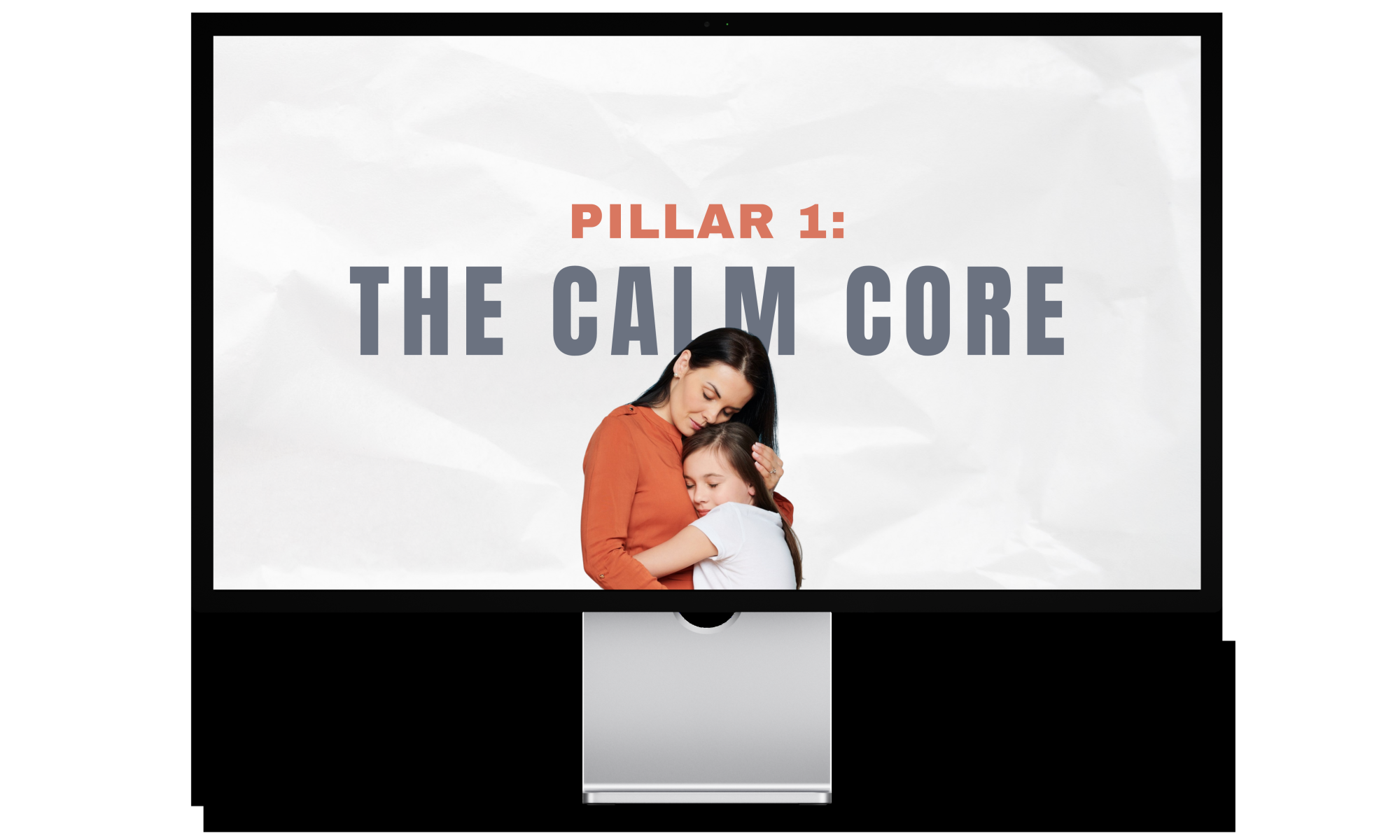
Pillar 1
The Calm Core
What to do when your body wants to explode before your brain can stop it
You already know what it feels like when the anger hijacks you before you even realize it's happening.
This pillar teaches you the 60-Second Reset — a nervous system technique built on actual neuroscience — that interrupts the hijack before it reaches your mouth. Parents who use this tell me they don't yell less because they're trying harder. They yell less because their body stops going there in the first place.
What you walk away with: One technique. 60 seconds. Works in the middle of the worst moment you've had this week.

Pillar 2
The Daily Ten
The 10 minutes that prevents 90% of the behavior problems before they start
After all my research, I kept running into the same data point: children whose parents gave them 10 minutes of undivided, fully present attention daily had dramatically fewer behavioral incidents. Not 1 hour of "quality time." Ten minutes. Specific, intentional, child-led.
This pillar shows you exactly what those 10 minutes look like — and why most parents accidentally do it wrong even when they're trying.
What you walk away with: A daily ritual so simple you'll wonder why nobody told you sooner.
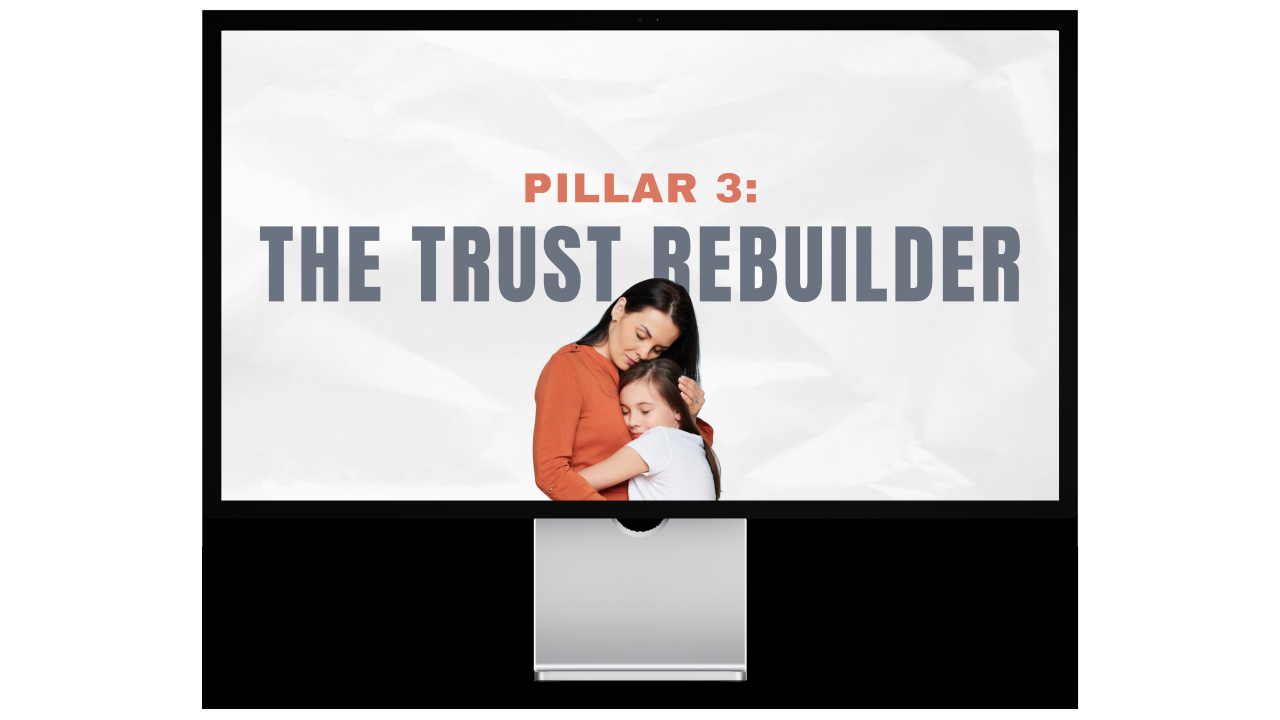
Pillar 3
The Trust Rebuilder
The exact words to say in the 60 seconds after you lost it — so your child's trust grows instead of shrinks
This is the pillar that changes everything. Most parents either over-apologize ("I'm so so so sorry, I'm terrible, I love you so much") or under-apologize ("I said sorry, okay?"). Neither works.
This pillar gives you the exact 3-step repair sequence that neuroscience confirms actually rewires your child's sense of safety. I used this for the first time with my daughter and she threw her arms around me. After years of distance. In one conversation.
What you walk away with: Three specific sentences. You'll use them tonight.

Pillar 4
The Micro-Ritual Code
The small things that fill your child's emotional cup before it runs out
Here's what I discovered the hard way: most behavioral explosions aren't about the moment. They're about what didn't happen in the 48 hours before.
This pillar teaches you the micro-rituals — small, daily, barely 2 minutes each — that keep your child's nervous system regulated before the chaos starts. These are the rituals that make Tuesday mornings different from Sunday nights.
What you walk away with: A menu of micro-rituals. Pick three. Start tomorrow.

Pillar 5
The Open Channel
How to make your child actually tell you what's wrong instead of acting it out
Your child isn't refusing to talk because they don't want to. They're refusing to talk because they don't have the words. And if they don't have the words, the feelings come out through behavior — hitting, screaming, shutting down, "I hate you."
This pillar teaches you how to give your child the emotional vocabulary they need and how to create the specific conditions where they feel safe enough to use it. When this clicks, parents tell me it feels like a completely different child.
What you walk away with: Conversation frameworks that actually open kids up instead of shutting them down.
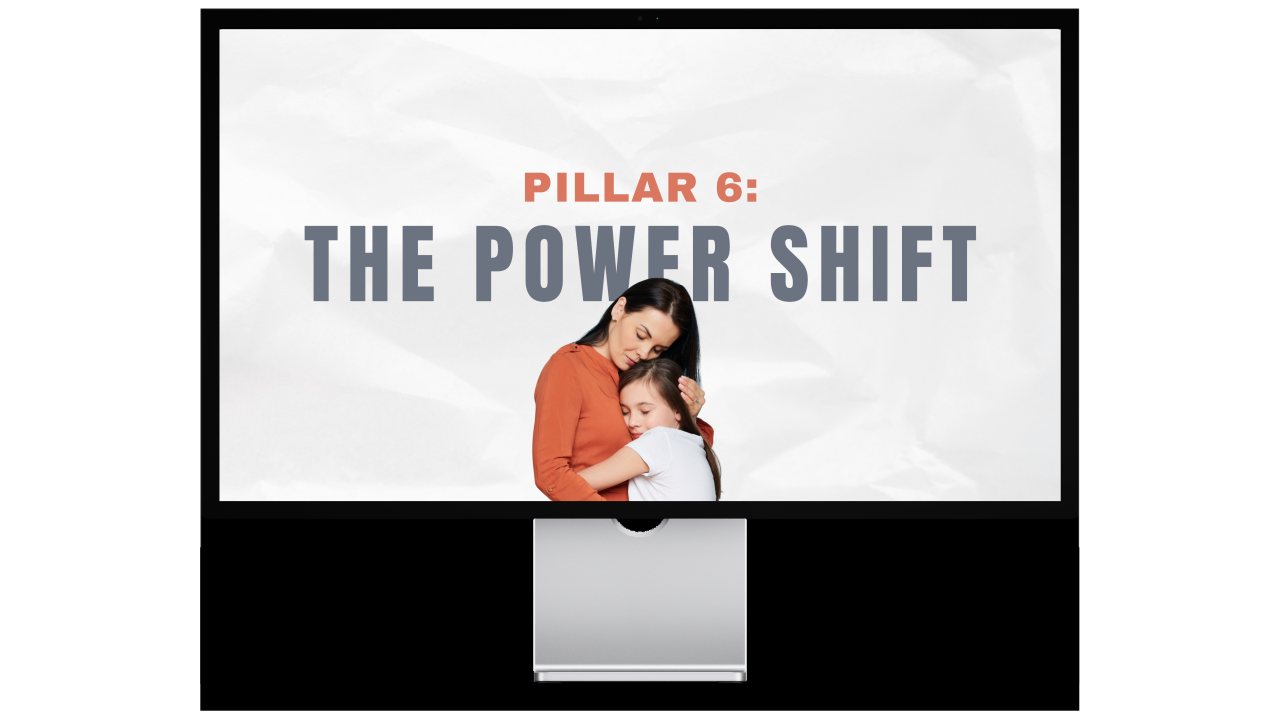
Pillar 6
The Power Shift
How to read what's underneath the behavior so you stop fighting symptoms and start solving causes
Every behavior your child shows is a message in code. "I'm tired" comes out as aggression. "I feel invisible" comes out as defiance. "I'm scared"
comes out as clingy behavior at exactly the wrong moment. This pillar teaches you how to decode that message in real time — so instead of reacting to the behavior, you're responding to the actual need. When you hit the real need, the behavior shifts automatically. Every single time.
What you walk away with: A behavior-to-need translation guide you'll use for the rest of your parenting life.

Pillar 1
The Calm Core
What to do when your body wants to explode before your brain can stop it
You already know what it feels like when the anger hijacks you before you even realize it's happening. This pillar teaches you the 60-Second Reset — a nervous system technique built on actual neuroscience — that interrupts the hijack before it reaches your mouth. Parents who use this tell me they don't yell less because they're trying harder. They yell less because their body stops going there in the first place.
What you walk away with: One technique. 60 seconds. Works in the middle of the worst moment you've had this week.

Pillar 2
The Daily Ten
The 10 minutes that prevents 90% of the behavior problems before they start
After all my research, I kept running into the same data point: children whose parents gave them 10 minutes of undivided, fully present attention daily had dramatically fewer behavioral incidents. Not 1 hour of "quality time." Ten minutes. Specific, intentional, child-led. This pillar shows you exactly what those 10 minutes look like — and why most parents accidentally do it wrong even when they're trying.
What you walk away with: A daily ritual so simple you'll wonder why nobody told you sooner.

Pillar 3
The Trust Rebuilder
The exact words to say in the 60 seconds after you lost it — so your child's trust grows instead of shrinks
This is the pillar that changes everything. Most parents either over-apologize ("I'm so so so sorry, I'm terrible, I love you so much") or under-apologize ("I said sorry, okay?"). Neither works. This pillar gives you the exact 3-step repair sequence that neuroscience confirms actually rewires your child's sense of safety. I used this for the first time with my daughter and she threw her arms around me. After years of distance. In one conversation.
What you walk away with: Three specific sentences. You'll use them tonight.

Pillar 4
The Micro-Ritual Code
The small things that fill your child's emotional cup before it runs out
Here's what I discovered the hard way: most behavioral explosions aren't about the moment. They're about what didn't happen in the 48 hours before. This pillar teaches you the micro-rituals — small, daily, barely 2 minutes each — that keep your child's nervous system regulated before the chaos starts. These are the rituals that make Tuesday mornings different from Sunday nights.
What you walk away with: A menu of micro-rituals. Pick three. Start tomorrow.

Pillar 5
The Open Channel
How to make your child actually tell you what's wrong instead of acting it out
Your child isn't refusing to talk because they don't want to. They're refusing to talk because they don't have the words. And if they don't have the words, the feelings come out through behavior — hitting, screaming, shutting down, "I hate you." This pillar teaches you how to give your child the emotional vocabulary they need and how to create the specific conditions where they feel safe enough to use it. When this clicks, parents tell me it feels like a completely different child.
What you walk away with: Conversation frameworks that actually open kids up instead of shutting them down.

Pillar 6
The Power Shift
How to read what's underneath the behavior so you stop fighting symptoms and start solving causes
Every behavior your child shows is a message in code. "I'm tired" comes out as aggression. "I feel invisible" comes out as defiance. "I'm scared" comes out as clingy behavior at exactly the wrong moment. This pillar teaches you how to decode that message in real time — so instead of reacting to the behavior, you're responding to the actual need. When you hit the real need, the behavior shifts automatically. Every single time.
What you walk away with: A behavior-to-need translation guide you'll use for the rest of your parenting life.
Each of the 6 pillars includes:
3 Specific Fixes you can implement TODAY to see immediate results with your child
Expert Audio Session - Two hosts break down the pillar topic in depth, sharing the science behind it and how to apply it in your daily life (listen in the car, during a walk, or while doing chores)
Printable Worksheets & Tracking Tools to help you implement each pillar and monitor your progress week by week
Step-by-Step Action Plans showing you exactly what to do in specific situations (bedtime battles, morning chaos, tantrums, defiance, etc.)
100 Ready-to-Use Connection Scripts and aever wonder "what do I say?" again.
"Pillar 3 alone is worth 10x what I paid. The repair sequence is so specific that the first time I used it, I had it written on my hand. My daughter is 11. Eleven-year-olds do not suddenly get emotional. She cried and said 'Mom, I've been waiting for you to say that.'"
— Michelle F., mom of 2 | London, UK
Premium Feature

CALM COACH AI — YOUR 3AM
PARENTING PARTNER
Look, I'm going to be straight with you.
Every parenting program has the same fatal flaw: the hard moments don't happen when you're sitting calmly at your desk with your workbook open.
They happen at 7am when you haven't had coffee. At 8:45pm when you're exhausted and your child won't sleep.
At a family dinner when you're surrounded by people watching you lose it in slow motion.
That's exactly why I built Calm Coach AI into this system.
Not as a chatbot. Not as an FAQ with a friendly interface.
As the thing I wish I had on my worst days — a parenting partner that knows the system, knows your triggers, and is available in the exact moment you need it most.
When you're 10 seconds from exploding:
Open Calm Coach. Type what's happening. Get your 60-Second Reset — personalized to your situation, right now, in this specific moment.
When you don't understand why your child keeps doing the same thing:
Ask Calm Coach. It'll walk you through the Pillar 6 behavior decoder for that exact behavior and give you a response strategy within 60 seconds.
When you've just lost it and you're standing outside their door:
Create custom action plans for situations you KNOW will be difficult (family gatherings, grocery store trips, bedtime)
When it's 3am and the guilt is eating you alive:
Calm Coach doesn't judge. It doesn't charge $200/hour. It doesn't have a two-week waiting list.
It just helps.
This isn't a feature. This is the thing that makes everything else in this system actually work in real life — not just on paper.
When you don’t know what to say, Calm Coach gives you the next sentence.
Use it in the exact moment you feel stuck — after yelling, during a meltdown, or when your child pushes you away.
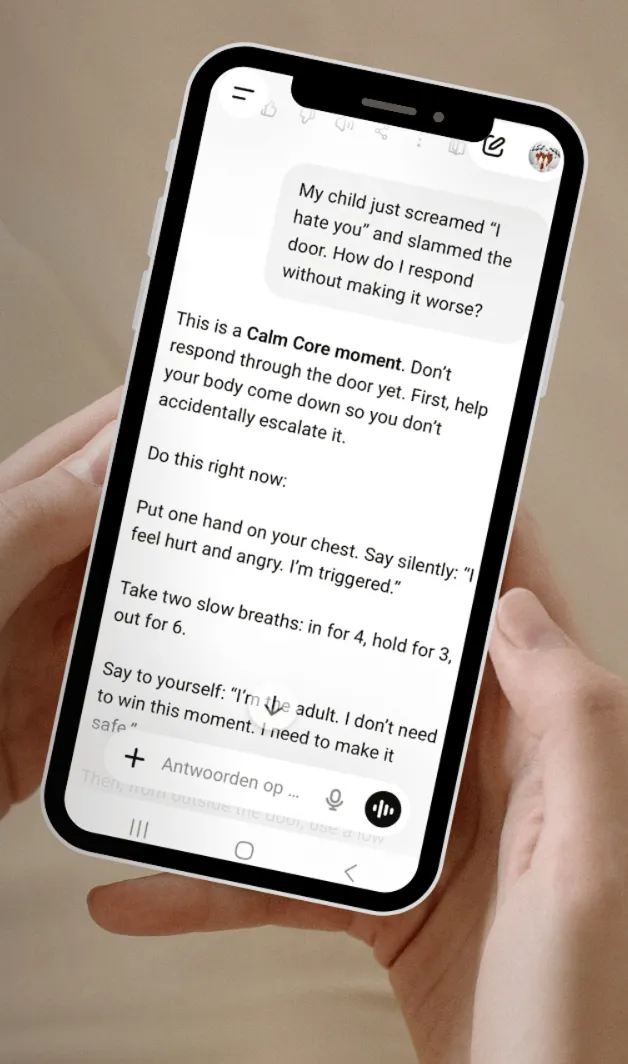
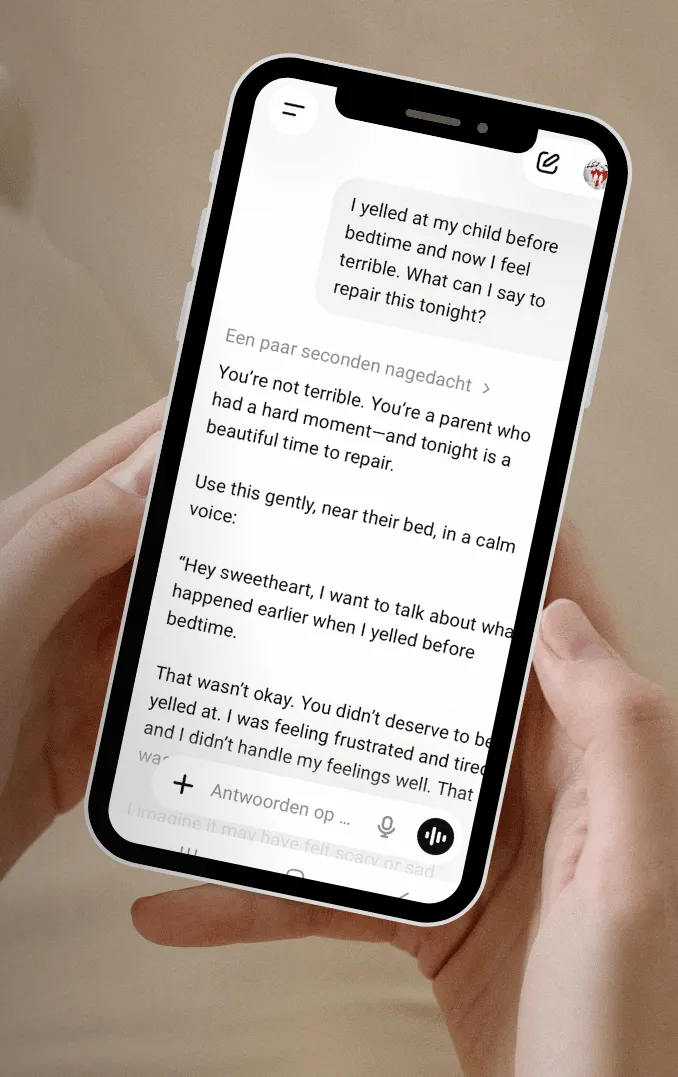
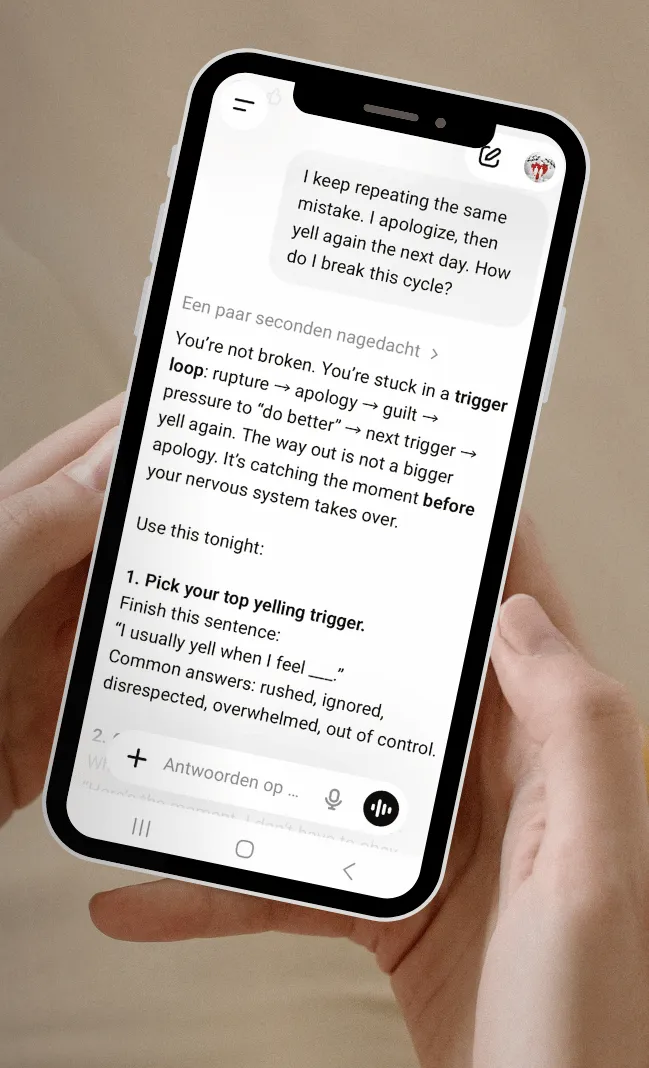
"I was mid-argument with my 7-year-old. Literally mid-argument. I stepped into the hallway, opened Calm Coach, typed what was happening, and had a repair script in 30 seconds. I walked back in and everything changed. My son looked at me like I was a different person. I kind ofwas."
— Marcus T., dad of 1 | Seattle, WA
WARNING!
THIS IS THE ONLY DEADLINE THAT ACTUALLY MATTERS
I'm not going to tell you this price expires at midnight.
I'm not going to pretend there are only 7 spots left.
What I wish someone had told me — before I wasted three more years — is that the only real deadline here has nothing to do with me.
It has everything to do with your child's brain.
Child neuroscience is clear on this: the neural patterns that determine how a child attaches to relationships — how safe they feel, how much they trust, how they'll handle conflict for the rest of their lives — are laid down predominantly between ages 4 and 12.
Not permanently. Not irreversibly. But with increasing resistance to change as each year passes.
Every week without repair isn't neutral. It's a week where the current pattern gets reinforced.
The guilt-yell-silence cycle doesn't just repeat. It compounds.
Each unrepaired rupture makes the next one slightly more normal to your child's nervous system — slightly more expected, slightly more proof that broken things stay broken.
The good news: repair compounds too. Every single time you come back — calm, honest, present — that wires in just as deep.
You have a window.
It's open right now.
That's the only countdown timer that matters.
When You Join Today, You'll Also Get These
I debated whether to include these as bonuses or just call them what they are:
the pieces that make the main system complete.
Because after working with thousands of parents, I know that the 6 pillars answer the biggest question — how do I repair and reconnect?
But there are two other questions that come up for almost every single parent. And I didn't want to leave you without answers to those either.
BONUS #1
The Developing Brain Guide
(Value: $97.Yours free today)
This is the guide I wish existed when my daughter was 6.
Most parenting advice treats a 5-year-old and a 10-year-old the same way. But neuroscience shows that the brain at age 5 is literally a different organ than the brain at age 10.
What I wish someone had told me was that half the things I was asking my daughter to do weren't just hard for her. They were neurologically impossible. Her brain wasn't built for it yet.
After reading this guide:
You'll stop asking your 6-year-old why they can't just control themselves — because you'll understand that the part of the brain that controls impulses isn't fully developed until age 25.
You'll stop taking your 9-year-old's eye-rolls personally — because you'll know exactly what's happening neurologically during pre-adolescence. And you'll know which of the 6 pillars to lean on most heavily at each stage of your child's development.
This guide turns every "why do they do that?" into "oh — now I get it.

BONUS#2
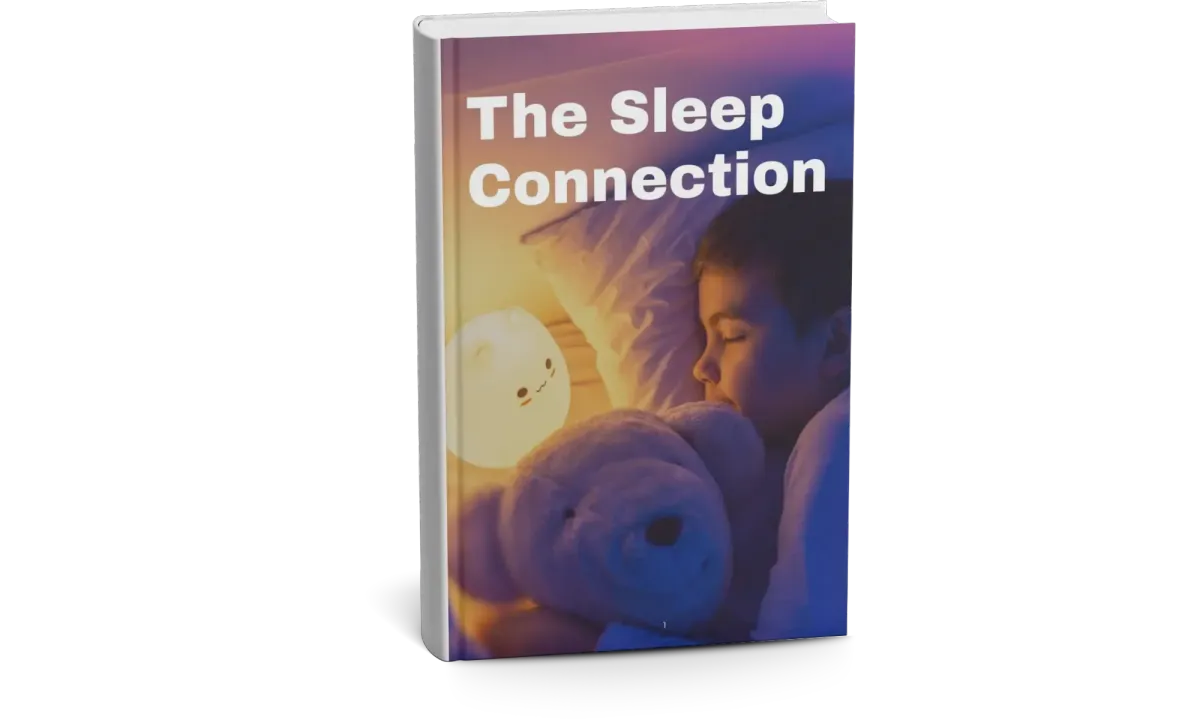
The Sleep Connection
(Value: $97.Yours free today)
I'm going to say something that might surprise you: most bedtime battles are not about sleep.
They're about a child whose nervous system hasn't finished processing the day. They're about unresolved tension from the 4pm argument that nobody talked about.
They're about a child who isn't sure where things stand between you before they close their eyes.
After three years of hell trying to solve my daughter's bedtime battles, I learned that the nights she went to sleep easily were always the nights we had repaired something during the day.
The nights she fought sleep hardest were always the nights something was left unsaid.
This bonus gives you:
The exact 10-minute bedtime ritual that signals to your child's nervous system that it's safe to power down.
The repair script to use before lights out so no unresolved tension carries into the night.
Parents who use this tell me bedtime goes from 45-minute battle to 10-minute ritual within the first week.
"I've spent $1,200 on family therapy in the last 8 months. I learned more that I could actually use in the first two pillars of this program than in all of those sessions combined. I'm not against therapy. But this is what gave me tools I could use on a Monday morning."
— Rachel H., mom of 1, age 7 | Sydney, Australia
"My daughter used to hide in her room when I came home from work. I thought that was just who she was. Twelve days after starting this program, she met me at the door. Twelve days."
— Jennifer L., mom of 3 | Chicago, IL
Your Investment Today:
JUST $7
I need to be straight with you about this price.
The complete system — all 6 pillars, Calm Coach AI, both bonuses — has a real-world value of $841. Parents have paid me $150 an hour to learn exactly what's inside.
So why $7?
Because I'm done watching the parents who need this most talk themselves out of it over price.
Seven dollars is less than your coffee this week. It removes every excuse.
And if you use even one of the 6 pillars tonight, you'll understand why 2,000+ parents call this the best $7 they've ever spent.
That's the only reason.
Here's everything you're getting:
The 10-Minute Connection Reset - 6 Complete Pillars (Valued at $379)
6 Expert-Hosted Audio Sessions (Valued at$71)
Calm Coach AI – 24/7 Personal Coaching (Valued at$197)
The Developing Brain Guide (Bonus #1) (Valued at $97)
The Sleep Connection System (Bonus #2) (Valued at $97)
Printable Worksheets & Implementation Guides (included)
100 Ready-to-Use Connection Scripts (included)
Total Real-World Value: $841
100% secure 256-bit encrypted checkout
THE "CALMER HOME IN 30 DAYS" GUARANTEE
I'm not going to ask you to trust me. I'm going to ask you to trust the system — and give you 30 days to prove it to yourself.
Here's my commitment to you:
Use the 6 pillars. Do the daily ten. Use the repair sequence once. Just once. If you don't feel a real shift in how your child responds to you within 30 days, email me at: [email protected] . I'll refund every single penny within 48 hours, no questions asked, no explanation needed.
And you keep everything. The pillars, the bonuses, the Calm Coach access. All of it.
So the actual risk of saying yes right now is zero. The only risk is saying no — and having the same week next week that you had this week.

FAQ
THE QUESTIONS MOST PARENTS ARE AFRAID TO ASK
Who are you and why should I listen to you?
Fair question. I'm Hale, and I spent 15 years researching this after my own daughter told me she wanted a different mom. That moment broke me. It also changed everything.
I'm not a therapist. I'm not a researcher with letters after my name. I'm a parent who went through 15 years of hell figuring out what actually works — and then spent years testing it with thousands of other parents to make sure it wasn't just luck.
The 40+ peer-reviewed studies in this system aren't my research. They're the science that explained why what I discovered intuitively was actually working. The system came first. The science confirmed it.
Is this just another parenting program that's going to make me feel worse about myself?
The first thing I want to say is — I get why you're asking that.
Most parenting content is built on the same unspoken message: "Here's everything you're doing wrong. Now do better." And every time you read it, you feel a little more broken.
This is built on the opposite premise.
The entire foundation of the Repair-First Method is that you are not broken. You were never broken. You were just missing one specific piece — what to do after the hard moment — that nobody ever taught you because most parenting experts were too busy telling you how to prevent the hard moment in the first place.
Prevention is a nice idea. Repair is what actually works in real life.
Parents who go through this program consistently tell me the same thing: they feel lighter after the first pillar, not heavier. Because for the first time, someone is telling them the truth — that the yell isn't the ending. The silence after it is.
I've done positive parenting, gentle parenting, read every book. How is this actually different?
Look, I'm going to be straight with you.
I've read those books too. I've done those courses. And they all have one thing in common: they're built for the version of you that exists before the hard moment hits.
They teach you to stay calm. To use the right words. To create the right environment. All of it assumes that if you just prepare enough, you won't lose it.
What I discovered the hard way is that preparation doesn't stop the hijack. When your nervous system goes into fight-or-flight — which happens faster than conscious thought — all the scripts and strategies disappear.
This system is built specifically for the moment after the hijack.
Not "how do I prevent this." But "this just happened — what do I do right now, in the next 60 seconds, to make sure it doesn't damage what I'm building with my child."
That's the gap every other approach leaves open. This is what fills it.
Will this work if my child is already pulling away from me?
Honestly? The parents who see the fastest results in this program are the ones who feel the most disconnected when they start.
And I know that sounds backwards. But after working with thousands of parents, I've seen it enough times to say it with confidence.
A child who is pulling away isn't a child who has given up on you. They're a child who has learned to protect themselves from repeated disappointment. The pulling away is a defense, not a verdict.
When you start showing up differently — consistently, with repair, with presence — that defense starts to soften. Not overnight. But faster than you'd expect, because children are neurologically wired to want connection with their parents. That drive doesn't go away. It just gets buried under enough unrepaired ruptures.
The parents who tell me their child "is a completely different kid" three weeks in? Almost always the ones who started with the most distance.
What if I yell again after I start the program?
You will yell again. I want to be honest about that.
And this is the part that matters most: that's not failure. That's the whole point.
The 10-Minute Connection Reset isn't a program that promises to make you someone who never yells. It's a program that teaches you what to do in the 60 seconds after you did — so that moment becomes the thing that builds trust instead of breaking it.
Every parent I've worked with has yelled during the program. The difference is what they did next.
Before the program: yell → guilt → silence → distance → repeat.
After the program: yell → 60-second reset → repair sequence → child feels safer than before it happened.
Same human. Same stress. Completely different result. Because now you have the mechanism.
How is this different from therapy?
Therapy is valuable. I've been in therapy. I'm not against it.
What I wish someone had told me was what therapy couldn't give me: something I could use on a Monday morning at 7:45am when everything was falling apart.
Therapy gives you insight. It helps you understand why you react the way you do, where it comes from, what it means. That work is real and it matters.
But insight doesn't stop the hijack. And insight doesn't tell you what to say when you're standing outside your child's door at 9pm with your heart in your stomach.
This program gives you mechanisms. Specific, repeatable, field-tested processes for the actual moments that are breaking your relationship. Not in theory. In practice. In your kitchen at dinnertime.
Many parents use both. The therapy helps them understand themselves. This program gives them something to do with that understanding in real time.
Will this work for my teenager?
This is an important question and I want to answer it honestly.
The 6-pillar system was built primarily for parents of children aged 4-12. The neuroscience it's based on is most directly applicable to that developmental window.
That said — I've had parents of 13 and 14-year-olds go through the program and report significant results, particularly with the repair protocol and the behavior-decoding work in Pillar 6. Teenagers still need repair. Teenagers still respond to genuine, specific apology. Teenagers still have unmet needs driving their behavior.
What changes with teenagers is the delivery. The Daily Ten looks different with a 14-year-old than it does with a 7-year-old. Calm Coach AI can help you adapt the frameworks in real time to your specific child's age and situation.
If your child is 13-15, this will likely still help you. If they're 16+, the core repair principles still apply, but I'd want to be honest that the program's sweet spot is the years before that.
What if my partner doesn't want to do this with me?
This comes up more than almost any other question. And the answer surprised me when I first discovered it.
You don't need your partner to do this with you for it to work.
The research on attachment shows that children only need one consistently repairing parent to develop secure attachment. One. Not two perfectly aligned co-parents running the same system in sync. One parent who shows up consistently with repair.
That can be you.
Now — will it work better if your partner is on board? Yes. And what I've seen happen more times than I can count is this: one parent starts the program, the dynamic in the house shifts visibly, and the other partner becomes curious. Not because they were convinced by an argument, but because they watched it work.
You don't need to convince anyone. Start with yourself. Let the results do the talking.
What exactly do I get when I join?
The moment you complete your order — which takes less than 60 seconds — you get instant access to:
All 6 pillars of the 10-Minute Connection Reset, including the video lessons, expert audio sessions you can listen to anywhere, and the printable worksheets for each pillar.
Calm Coach AI — available immediately on your phone, 24/7, for real-time support in any parenting moment.
The Developing Brain Guide — so you understand the neuroscience behind your child's behavior at every age.
The Sleep Connection System — the bedtime ritual and repair protocol that ends the nightly battle.
100 ready-to-use connection scripts so you never stand there thinking "I have no idea what to say right now."
Everything is mobile-accessible. You don't need to sit at a desk. You can listen while you drive, read while you wait at school pickup, and use Calm Coach in the school parking lot before you walk into the house.
I've wasted money on programs before that didn't deliver. Why is this different?
After three years of buying things that didn't work, I learned the difference between programs built to sell and programs built to work in real life.
Programs built to sell give you information. Lots of it. Beautifully organized. With great production value. And then leave you alone with it.
This is built around the moment the information fails you — which, if you're human, will happen. Calm Coach AI exists specifically for that moment. It's the thing I kept wishing I had when I was in the middle of a blowup with no idea what to do next.
And then there's the guarantee. 30 days. Full refund. Keep everything.
So here's what I want you to actually hear: you are not risking $27. You are risking nothing. If this doesn't shift something real in your relationship with your child within 30 days, I'll give you every penny back without a single question.
The only thing you're actually risking right now is not trying it.
I'm so exhausted. I don't have the energy for another program.
This is what I wish someone had told me when I was in that exact place.
You don't need more energy for this. You need less wasted energy.
Right now, a significant portion of your daily emotional bandwidth is going into the guilt after the hard moments, the eggshell-walking before the next one, and the low-grade anxiety of not knowing what to do when it happens again.
That's exhausting in a way that's invisible — because you're not doing anything, you're just carrying it.
The parents who tell me they're "too tired" and then join anyway almost always say the same thing two weeks in: "I didn't realize how much energy the cycle was taking until it started breaking."
You don't need to be at full capacity to start. You need to start to get back to full capacity.
Picture Your Life 30 Days From Now...
In 30 days, you could be living this reality:
• You wake up to your child saying "Good morning, Mom/Dad" with a smile instead of a complaint.
• You have a moment of frustration, but instead of yelling, you use the 60-Second Reset. You stay calm. Your child feels safe.
• Later that day, you have your 10-minute connection time. Your child opens up about something that's bothering them. You listen. You understand. You connect.
• That evening, you use the Repair Protocol to address a mistake you made earlier. Your child accepts your apology. Your relationship feels stronger, not weaker.
• You journal with Calm Coach about your triggers. You see patterns you never saw before. You feel understood.
• And most importantly? Your child looks at you with trust. Not fear. Not resentment. Trust.
This isn't a dream. This is what happens when you have the right system and you implement it consistently.
Imagine if...
• Your child ran TO you instead of away from you
• Bedtime became peaceful instead of a battle
• You felt proud instead of guilty at the end of each day
In 30 days, you could be living this reality.
✅30-Day "Calmer Home" Guarantee — Keep everything even if you refund Instant access.
Start tonight.

BEFORE YOU CLOSE THIS PAGE
I want to say one thing directly.
You didn't end up here by accident. You clicked because something you saw or heard today reflected something you've been living with — maybe for months, maybe for years.
That feeling in your chest right now? That's not guilt. That's love looking for a way out.
The parents who get results from this program aren't the ones who had it easy. They're the ones who were tired enough of the same week repeating itself to try something different.
You have two choices right now:
Close this page and go back to what you've been doing. Tomorrow will probably look a lot like today. That's not a judgment — that's just what happens when nothing changes.
Or join today and give yourself 30 days to find out what's possible when you have the right mechanism — not just the right intentions.
Your child isn't asking you to be perfect.
They're asking you to come back.
P.S. The first parent who used the Repair Protocol from Pillar 3 texted me at 10:47pm on a Tuesday. She wrote: "I don't know what just happened but my son let me back in his room.
He hasn't done that in four months." That was 11 days after she started. If you're still reading this, you already care enough to be that parent. The only thing left is to start.
P.P.S. You've probably spent more than $7 this week on things you won't remember by Friday.
This is $7 toward something your child will feel for the rest of their life. That math is easy.
Still on the fence?
Remember...
You're protected by our 30-day "Calmer Home Or It's Free" guarantee
You get over $841 worth of value for just $7
This introductory price won't last long
The only way you can lose is by not taking action today
100% Secure · 256-Bit Security Encryption
P.S. Imagine 30 days from now. Bedtime is no longer a battle. Your child actually runs to you instead of hiding in their room.
You haven't yelled in weeks — not because you're holding it in, but because you finally know how to stay calm when it matters most.
That's not a fantasy — it's exactly what parents experience when they implement the 6-Pillar System.
Don't wait until your child stops talking to you completely — take control now with this risk-free opportunity to rebuild your connection for just $7.
P.P.S. Let's be honest — you've probably spent more than $7 on a single parenting book that's still collecting dust on your nightstand.
Or a therapy session that gave you insight but no practical tools for Tuesday morning when your kid refuses to put on shoes.
This is an investment in actually enjoying your child again. In hearing "I love you, mama" instead of "leave me alone." Isn't that worth at least as much as another Amazon order you'll forget about by next week?
Secure your access now before this price goes up.
READY TO TAKE THE FIRST STEP?
Your Child Needs You to Take This Step
Not because you're broken. But because you care enough to grow.
Support